Ingeniero · Engineer
Engineer & Software Pioneer
“It all started with my love for Mathematics, and Operations with Matrices Transformations (the basis for Computer Graphics).”
From the “Pioneer” page on XunaSoft.com, which he called a “legacy web” for his children.
Radars, avionics and airline networks (1974–1980)
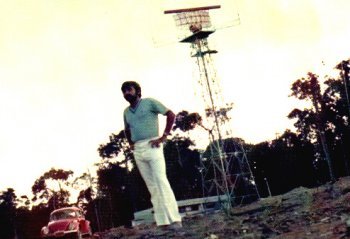
After graduating in electrical engineering in 1974, he joined Airborne Instruments Laboratory (AIL) on Long Island as a radar engineer and international trainer. He worked on the development and field installation of secondary surveillance radars (AN/TPX-42), travelling to Venezuela, Colombia and Brazil to install them at airfields and to train air-traffic controllers on these systems. At Manaus, in 1976, the airport “was being transformed from a local to International.”
He was then regional manager for the Middle East and West Africa (and international sales manager for Europe and French Africa) for Databit, a multiplexer and modem manufacturer. From 1977 to 1980 he was a Telecommunications Officer for British Airways in New York. He was part of a small team of engineers who maintained the BOADICEA reservation system, at the time one of the world's largest long-haul telecom networks, flying on call to BA offices at JFK, Dulles and Logan for on-site repairs.
A software pioneer (1978–1994)
His first extensive program, copyrighted in 1979–80, was a 3-D graphics program written in BASIC: it loaded the vertices of a pyramid, prism or cylinder and, simply by multiplying matrices, scaled, rotated, sheared and moved the solid on the screen. “Under your eyes the solid was moving or transforming. That was something! All that done with 10Kb OS (ROM), and 32Kb RAM.”
Then he turned to business applications, a “manipulator of data banks.” In 1978, he wrote, “we would refer to these programs as manipulators of Cross-Referenced Archives,” because the word database was not yet in common use.
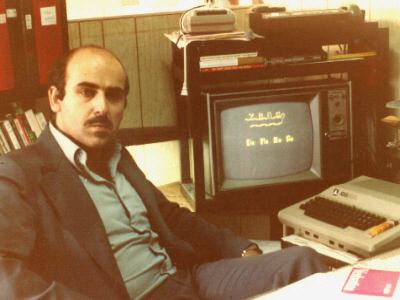
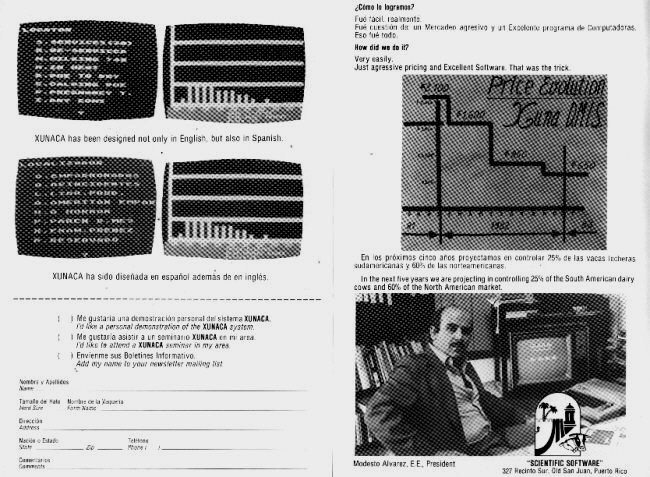
He founded and registered Scientific Software in Suffolk County, New York, and in January 1981 opened its doors in Old San Juan, Puerto Rico, to work on it full time. In early 1982 he finished XUNA D.M.I.S., a Dairy Management Information System. He described it as “a powerful DB; color, graphs, all crammed in 100 KB,” written in BASIC (a 10K operating system, an 8K interpreter and a 36K database). Its efficiency came from a method he called “Nucleolic Programming.” The combination of hardware and software was sold as XUNACA.
“A serious database business application for a micro-computer was unheard of!! Software for micros was a scarce, and a novelty. The term software was not recognized by most people, but the term ‘computer program’ was common.”
The press took notice. He counted eleven local newspaper articles, three articles in major farming magazines and three appearances on San Juan TV. Despite that, he had to close the company in 1984 for lack of venture capital: “This newly emerged type of software was unfamiliar territory for venture capitalists.”
He tried again a decade later. He founded DairySoft in Boulder, Colorado, and in 1991–92 Animal Science Software International in Two Rivers, Wisconsin, with “DECADE D.M.I.S.” (1993), the dairy system rewritten in C for all kinds of PCs. Despite “good accolades from farmers and journalists,” it met the same fate for the same reason. As he put it on his hub page: “As a software developer I had both, great satisfactions and some sour grapes.”

Registered copyrights
Each work is listed on his timeline with its U.S. Copyright Office registration number:
| Year | Work | Registration |
|---|---|---|
| 1980 | “3D-Graphics” (math transformations, a first on Atari) | TXu 52-171 |
| 1981 | “Nucleolic Programming” (paper: “super compacted modular design”) | TXu 65-219 |
| 1982 | “XUNA D.M.I.S.” | TXu 74-195 |
| 1990 | “A Decade with Nucleolic Programming” | TXu 470-416 |
| 1991 | “US Energy Policy: S.O.S. [Scared Ostrich Syndrome]” | TXu 494-108 |
| 1993 | “DECADE D.M.I.S.” | TXu 90-917 |
| 2008 | ZUET presentation | TXu 637-935 |
Manufacturing and test engineering: StorageTek (1986–1991)
In Puerto Rico he was a production manager at Columbia Data Products (Gurabo) and at Storage Technology (Ponce), with hundreds of manufacturing and testing employees reporting to him. At StorageTek he became Board Test, System Test and Production Manager. In 1988 he was transferred to headquarters in Louisville, Colorado, where “many test routines were implemented using my ‘nucleolic’ coding.” His résumé lists:
- the ROSI formula (“Rework or Scrap Intelligently”), a curve-fitting method based on a Hermite polynomial that became the standard tool for deciding the disposition of electronic boards in Colorado and Puerto Rico;
- “Chameleon,” a channel emulator written in C to diagnose solid-state memory devices;
- AUTO-MDL (“Toucan”), an automatic machine-defect log in C with Informix on UNIX, which he called “perhaps the most critical piece of software that I created at STK”;
- AUTS-Tape, an automatic, unmanned unit-test system for tape products.
International business: LodgeNet (1994–1997)
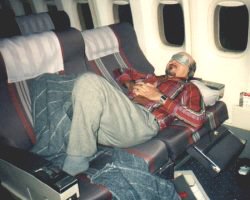
At LodgeNet Entertainment (hotel pay-per-view, video on demand and interactive TV) in Sioux Falls, South Dakota, he started and directed the company's international operations as Manager of International Licensing. He negotiated hardware and software licensing agreements with partners in Latin America and Asia, and LodgeNet's systems were deployed in Japan, Korea, Brazil, Panama, Peru, the Dominican Republic and Venezuela. “Frequent Flyer travelling internationally,” his timeline notes for those years.
Databases for Sprint: Independent Technologies (1997–2002)
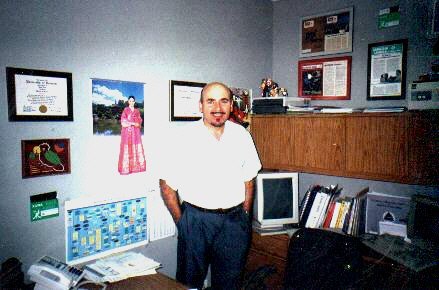
At Independent Technologies (ITC) of Omaha, a maker of test sets and systems for payphones, he was first a freelance GUI developer and then, from June 1998, Director of Software. For ITC's main client, Sprint, he built “Contracts and Commissions” (C&C), an Oracle client/server application in Visual C++ with ODBC that administered 50,000 payphone contracts and calculated commissions on 60,000 payphones. For two years he had an office at Sprint's headquarters in Overland Park, Kansas. In June 2000 he was promoted to Vice President of International Sales, based in Florida and travelling often to Latin America.
Polyglot and web builder
He speaks Spanish (and Galician) natively, as well as Portuguese, French and English, and follows conversation in Italian, Romanian and Catalan. His language skills list C, C++, Java, Visual C++, SAS, Prolog, COBOL, Fortran, BASIC and assembly, along with Oracle, Informix and ODBC. From 1998 he designed websites with Microsoft FrontPage, “close to 100 websites” by his count, mostly for personal and family projects.
Sources: XunaSoft.com (“Pioneer,” “Plant Manager,” “Summary,” “News & Articles”); JXPE.com (“More Detailed” résumé, Spanish CV); xuna.com (“Career,” biography); EHXS.com (“Who is JX,” “SoftwDev”).